
Solary’s Wharf: The Lost Steamboat Gateway of Lake Jesup
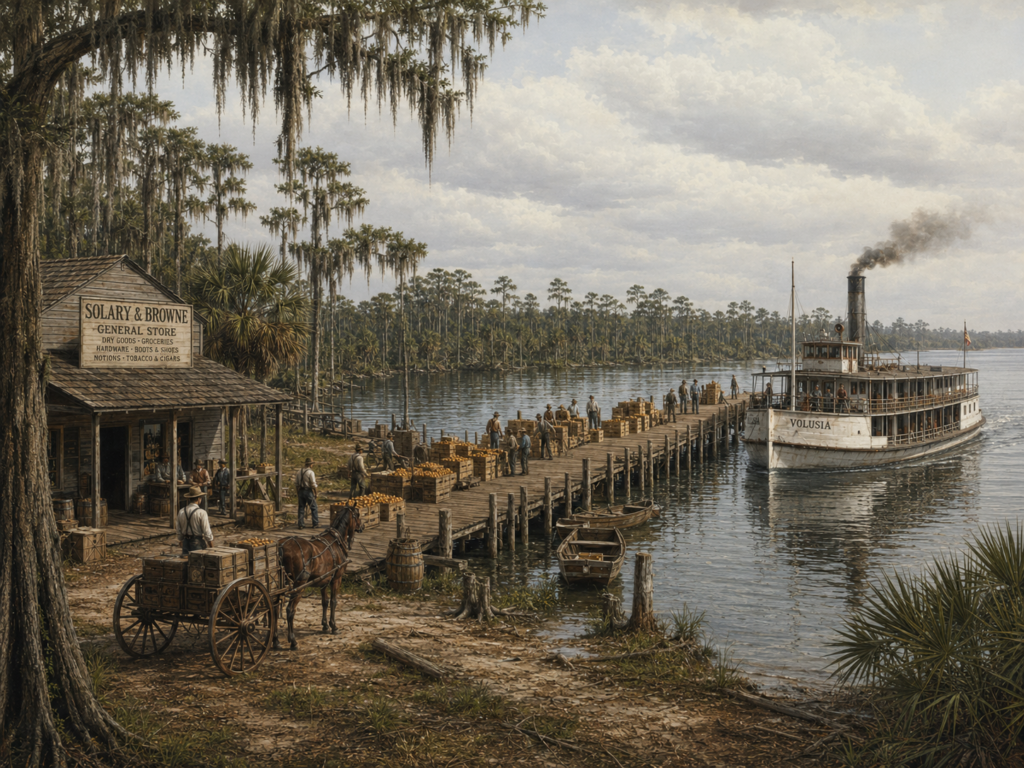
Along the swampy, cypress-fringed shores of Lake Jesup near Black Hammock, the landscape feels almost frozen in time. Today, the quiet is broken only by the low grunt of a bull alligator, the sudden slap of a mullet, or the distant roar of an airboat skimming across open water.
Strip away the modern asphalt and the faint hum of traffic from the State Road 417 bridge, however, and this marsh was once a loud, muddy engine of Florida frontier commerce.
In the 1870s, the rhythm of daily life was set by the chug of steam engines and the splash of wooden paddle wheels. Dockworkers hauled crates of sweet citrus under a relentless sun as a deckhand called across the dark water: “Let her drift! Heave the line!”
Before iron rails or paved roads carved through the interior, the St. Johns River system was Central Florida’s true highway. At the center of the region’s early boom stood Solary’s Wharf—a frontier steamboat port, post office, general store, and political battleground that served as the lifeline for early Oviedo, Lake Charm, and the surrounding settlements.
Today, a Seminole County historical marker at Black Hammock Marina commemorates the wharf and the pioneer settlement. Yet for decades, local historians and nearby residents have harbored a quiet doubt: does the marker actually stand where the wharf once did?
We will pinpoint its true location—but first, let’s step into the story of Central Florida’s lost steamboat port.
The Lake Jessup Settlement
In the years following the Civil War, homesteaders streamed into Florida’s interior to claim land under the Homestead Act. The St. Johns River was the region’s only true highway, but its steamboat routes ended at Mellonville (now part of Sanford). From there, settlers had to press southward into the wilderness on foot or by wagon, dragging supplies through sugar sand, wading unbridged creeks, and hacking through saw palmetto.
The scattered pioneers settling south of Lake Jesup gradually tamed the land into what became known simply as the “Lake Jessup Settlement”—spelled with two s’s, as was standard at the time.
Among the earliest arrivals was Joseph B. Watts, who homesteaded near present-day Oviedo High School in 1863. A former wealthy planter who once held at least 72 people in slavery, Watts ventured into the Florida bush with his daughter (Henrietta), his son-in-law John F. J. Mitchell, and several enslaved workers in a desperate bid to escape the Civil War and preserve his plantation lifestyle. The reprieve was brief: when news of the war’s end finally reached the shores of Lake Jesup, his workers became free men.
Mitchell, a Virginian by birth, soon struck out on his own. Around 1868, he filed a homestead claim east of modern-day Oviedo High School near Franklin Street and set out to cultivate citrus. Mitchell also served as the settlement’s de facto physician—affectionately known as “Dr. Mitchell,” despite holding neither a medical degree nor a license. Such was the improvised nature of frontier life.
As his young groves began to bear fruit, Mitchell confronted the settlement’s biggest hurdle: getting farm produce to distant markets. To solve the problem, he built a wooden dock along the southeastern curve of Lake Jesup, near modern Black Hammock Marina, and established a nearby trading post. He acquired the lakefront plot from George and Patience Powell.
For the isolated homesteaders, Mitchell’s landing became an immediate lifeline. Moving goods across the water was far more reliable than the grueling, multi-day ordeal overland.
Yet Mitchell’s port suffered from a fatal flaw: its approach was shallow, choked with mud, and guarded by stubborn sandbars. Heavy-laden steamboats couldn’t get anywhere near the shore, leaving settlers dependent on small skiffs and rowboats to ferry cargo back and forth in a slow, labor-intensive crawl.
Solary’s Frontier Gambit
After visiting the primitive Mitchell outpost, a savvy Jacksonville merchant and manufacturer named Antonio Solary saw an opportunity. He scouted the Lake Jesup shoreline around 1872. Roughly a quarter-mile west of Mitchell’s shallow dock, Solary discovered a sweet spot: a place where the lake bottom dropped steeply into a navigable six-foot channel.
Those two extra feet of water changed everything.
Solary built a substantial pier directly into the deep channel, transforming his wharf into the primary southern terminus for major steamboat lines on Lake Jesup. Vessels like the Volusia of the Clyde Steamship Company, captained by Thomas Lund, established regular passenger and freight runs straight to Jacksonville. A parade of other steamboats soon followed—the Chimo, Welaka, Rosa, George M. Bird, and the Isis.
Solary’s Wharf quickly outpaced rival landings at White’s Landing and Brantley’s Wharf, becoming the undisputed commercial engine of the lake.
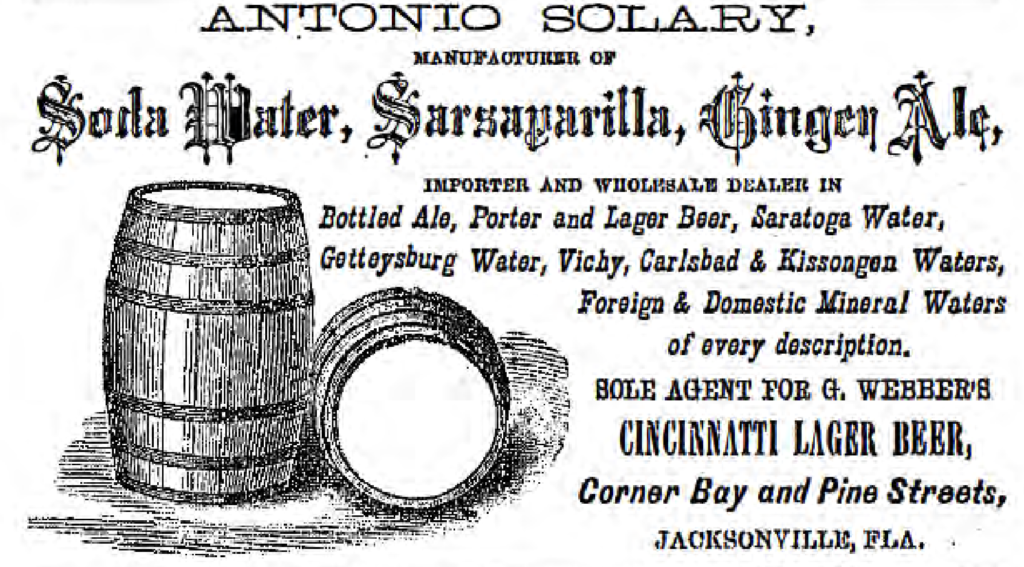
Yet Solary built more than a steamboat dock. Alongside the pier, he opened a bustling general store stocked with dry goods, groceries, and his own signature line of bottled soda water, sarsaparilla, ginger ale, and lager beer. Because Solary managed his broader business empire from Jacksonville, he appointed an ambitious 1871 newcomer, George H. Browne, to run the local operation. Browne proved so astute that Solary eventually made him a full partner.
In 1874, the federal government approved their application to establish a post office inside the store, naming Browne the region’s first postmaster. The operation exploded: by 1879, the landings along Lake Jesup were processing over 24,000 incoming and outgoing packages a year.
The store and post office became the de facto town square—a frontier hub where pioneers gathered to barter citrus, debate land claims, and cast their ballots on election days as the area’s sole polling precinct. Immersed in the political pulse of the community, Browne stepped directly from country storekeeper into public office. He was elected to the Florida House of Representatives in 1880, rising to become Speaker of the House by 1887.
The Pioneers at the Dock
The official polling record for the historic 1876 election at the Lake Jessup Precinct offers a roll call of the families who built the surrounding community:
| Lake Jessup Precinct Voters in November 7, 1876 Election | ||
|---|---|---|
| W. C. Parker T. J. Lawton A. C. Lawton R. W. Lawton M. E. Brock James H. Lee John V. Michell J. M. Jones A. B. Beall J. S. Womble B. F. Whitner, Jr. B. F. Whitner Jessie G. Minton John O. Fries Robert W. Iverson W. P. Lassiter J. J. Harris James H. King H. J. Lilyebjom C. A. Love Samuel Hodges | S. J. L. Hooker J. W. Prevatt Joseph M. Prevatte J. F. Prevatte Dougal Priest George Hatchett William H. Conley William Dozier J. W. Hicks J. Swanson William C. Drawdy Oliver W. Prince Ichabod Philips Alex. Foreman William T. Arnold J. S. Rouse Martin Powell Willis A. Rouse J. A. Silcox J. P. Long D. C. Hart | W. H. Tanner J. F. Douglas Calvin Prince William H. Carter J. D. Hart John V. Redditt John Young John Tanner J. P. Hart George C. Brantley George C. Powell B. Z. Hunter George H. Brown George W. Powell J. T. Nix W. L. Cromer Charles H. Smith A. H. Davis D. P. Godfrey John F. J. Mitchell J. W. C. Parker |
The Tragedy of the S. S. Isis
By the early 1880s, Oviedo’s orange groves were producing thousands of crates of fruit each season. Yet local growers felt increasingly squeezed by high freight tariffs charged by northern shipping lines, which ate heavily into their margins.
Determined to break this monopoly, local leaders took matters into their own hands. In April 1881, Antonio Solary, George H. Browne, Andrew Aulin (the founder of Oviedo), and Dr. Henry Foster pooled their resources to form the Lake Jesup Steamboat Company. Neighbors and growers quickly rallied around the venture, investing their savings as shareholders—including J. H. King, Henrietta L. Mitchell, W. G. White, and E. A. Jelks.
For the community, controlling their own route to market became a source of immense pride. The new company purchased an interest in the S.S. Isis, a 100-foot, flat-bottomed, iron-hulled steamboat already operating on the St. Johns River under Captain Eugene Bigelow. They refitted and upgraded the vessel, expanding its cargo capacity and adding a second smokestack. By December 1881, the newly improved Isis made its inaugural run to Solary’s Wharf, loading crates of fresh citrus bound for Jacksonville and markets far beyond.
The triumph, however, was tragically short-lived.
On November 6, 1882, while crossing the wide, treacherous waters of Lake George during a severe storm, the Isis was overwhelmed by high waves and sank. Three crewmen died with the ship.
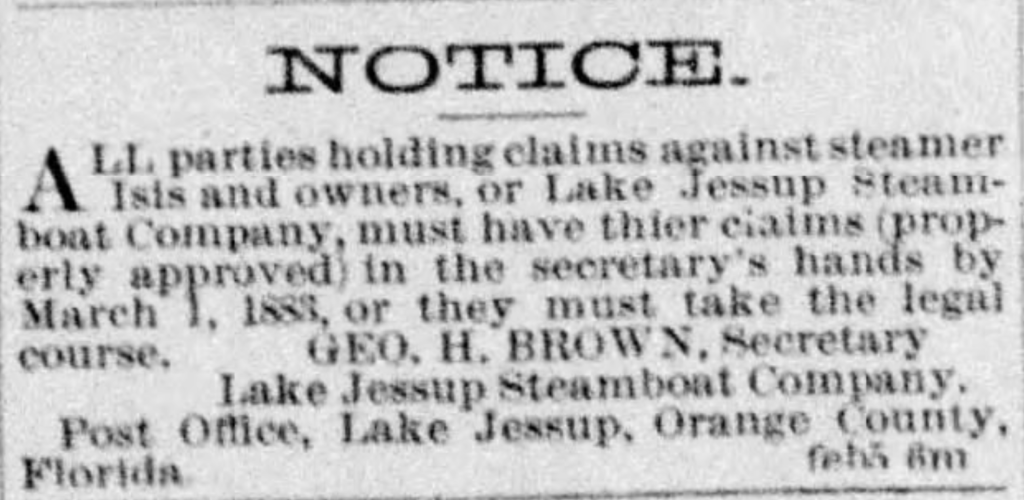
Efforts to raise the heavy iron hull from the lake bottom proved fruitless. Worse still, a cruel loophole in the insurance policy was revealed: it covered fire, but not storm damage. The uninsured disaster wiped out the company’s capital and devastated the finances of its principal investors. Forced into bankruptcy, the Lake Jesup Steamboat Company collapsed, leaving local growers once again at the mercy of outside shipping lines.
The 11-Cent Revolt and the Coming of the Iron Horse
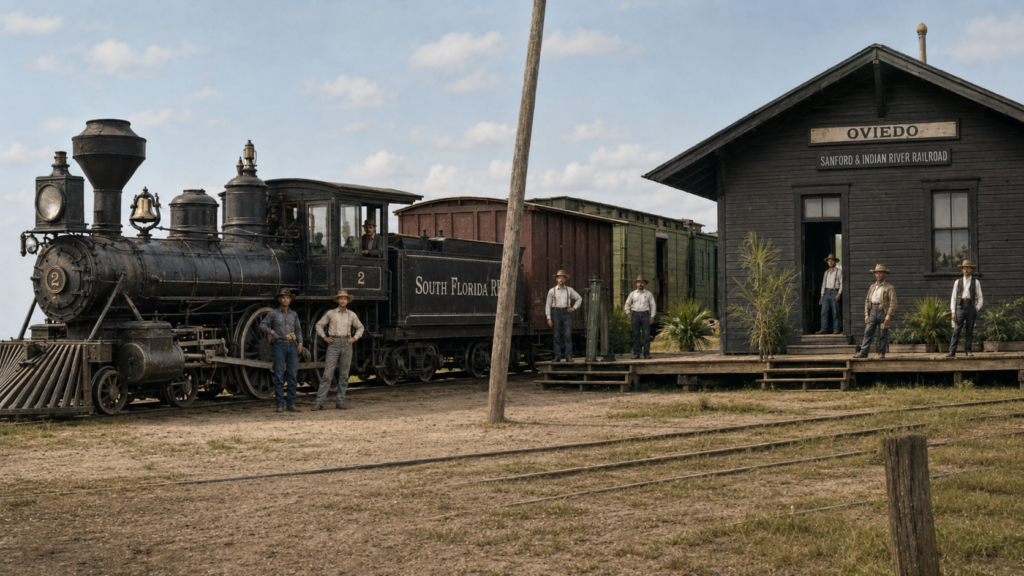
For nearly fifteen years, Lake Jesup’s steamboat landings held a virtual monopoly as the only practical gateway to market. That dominance began to slip in June 1885, when the Sanford and Indian River Railroad opened service into downtown Oviedo, expanding east to Lake Charm the following year. For the first time, growers of citrus, celery, and produce had a direct rail route north.
At first, the railroad offered a fair rate of five cents per box. But in 1888, once growers began relying on the tracks, the railroad abruptly doubled its freight rate to eleven cents a box.
Outraged by what they saw as corporate extortion, the community revolted. Once again, Dr. Henry Foster rallied the region, joining forces with the DeBary Steamship Company to incorporate the Oviedo, Lake Charm and Lake Jesup Railroad.
DeBary and Foster became the primary backers, while Browne, Solary, and Jelks stepped up for a second attempt at building a locally controlled transit network. They were joined by a “who’s who” of pioneer investors: W. E. Alexander, Theodore Mead, Meredith Brock, J. B. West, J. M. Jones, T. H. Willingham, A. Wahlstrom, Joseph Leinhart, Alexander Atkinson, and members of the Lawton and Nelson families.
Their strategy was a bold counter-strike: construct a short railroad connecting Lake Charm and downtown Oviedo straight to Solary’s Wharf, bypassing the main line and putting fruit back onto DeBary steamboats bound for Jacksonville.
Work moved fast. In February 1889, steamboats delivered 125 tons of iron rail to Solary’s Wharf. Crews laid over two miles of track toward Lake Charm, and railcars were readied for service.
Then, the venture ran into a double wall of friction.
First, despite being a shareholder, W. E. Alexander stubbornly refused to grant a right-of-way across his property, “Alexandria”—infuriating growers like the Lawtons and Nelsons whose groves depended on the downtown connection. Second, Solary’s Wharf required costly structural reinforcement to bear the crushing weight of a locomotive.
As construction stalled into October 1889, the South Florida Railroad blinked. Realizing the growers were serious, the railroad panicked and slashed its rate down to seven cents per box.
That rate cut killed the project—and fulfilled its true purpose. With cheaper rail rates secured, the financial incentive for the Solary’s Wharf route vanished. The unfinished line was abandoned, and its unused iron rails were sold off.
While the DeBary Steamship Company lost its investment and watched steamboats lose ground to the “iron horse,” local growers scored a massive victory. By threatening to build their own infrastructure, they had forced a railroad monopoly to bow. Dr. Foster—whose vast groves at Gee Hammock (now Winter Springs) were also served by the main line—had secured cheaper transit for the entire region without ever running a single train.
The Detective Work: Pinpointing the Lost Landing
So if the famed wharf of Antonio Solary and George Browne wasn’t at Black Hammock Marina, where was it?
Though the original field notes of frontier surveyor John Otto Fries have been lost to time, historical clues leave a clear trail to follow.
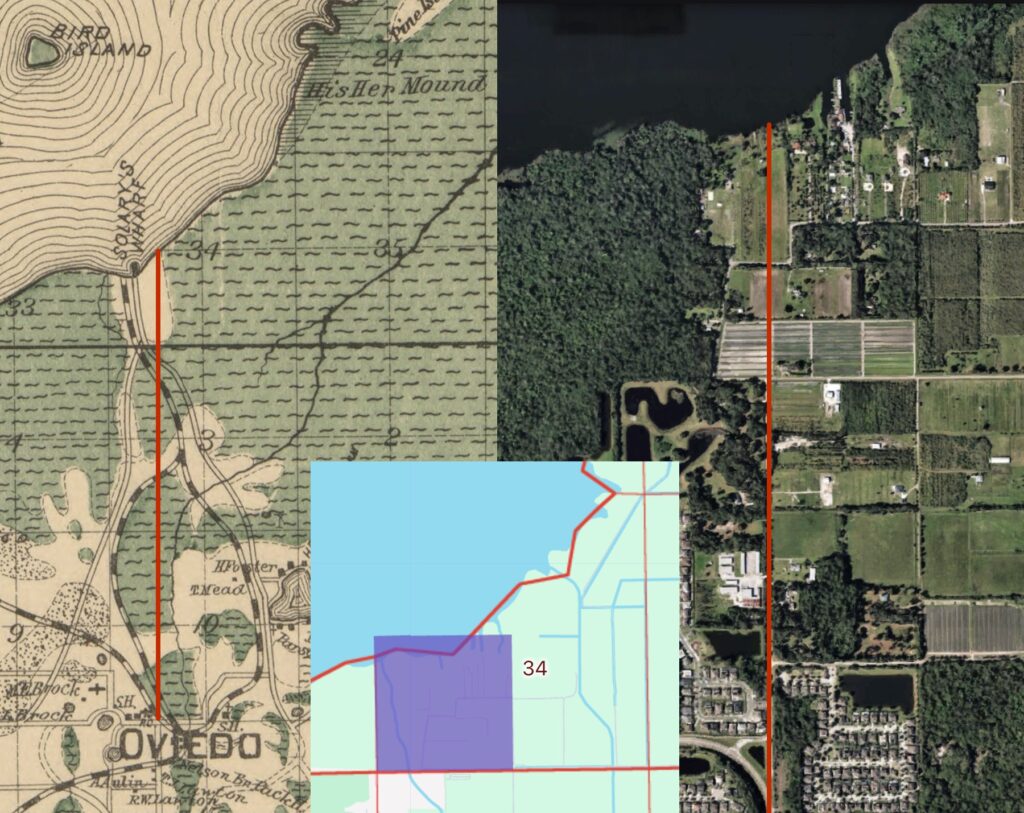
The first clue comes from official United States Postal Service records, which place the Lake Jesup Post Office in the southwest quarter of Section 34, roughly two and a half miles north of downtown Oviedo. While Black Hammock Marina sits right on the boundary line of that quadrant—making it technically possible—period maps paint a very different picture.
On John Otto Fries’s detailed 1890 map of Seminole County, following the line directly north from Oviedo’s central intersection at Broadway and Central (modern-day State Road 434) reveals a key discrepancy. Fries clearly places Solary’s Wharf west of that line, sitting halfway between the road and the mouth of Sweetwater Creek. The modern marina and boat ramp sit well to the east.
A second piece of evidence lies in an 1881 nautical chart, which recorded Lake Jesup’s depths and marked crucial landmarks along the shore, including White’s Wharf, Solary’s Wharf, and the Sweetwater Creek inlet.
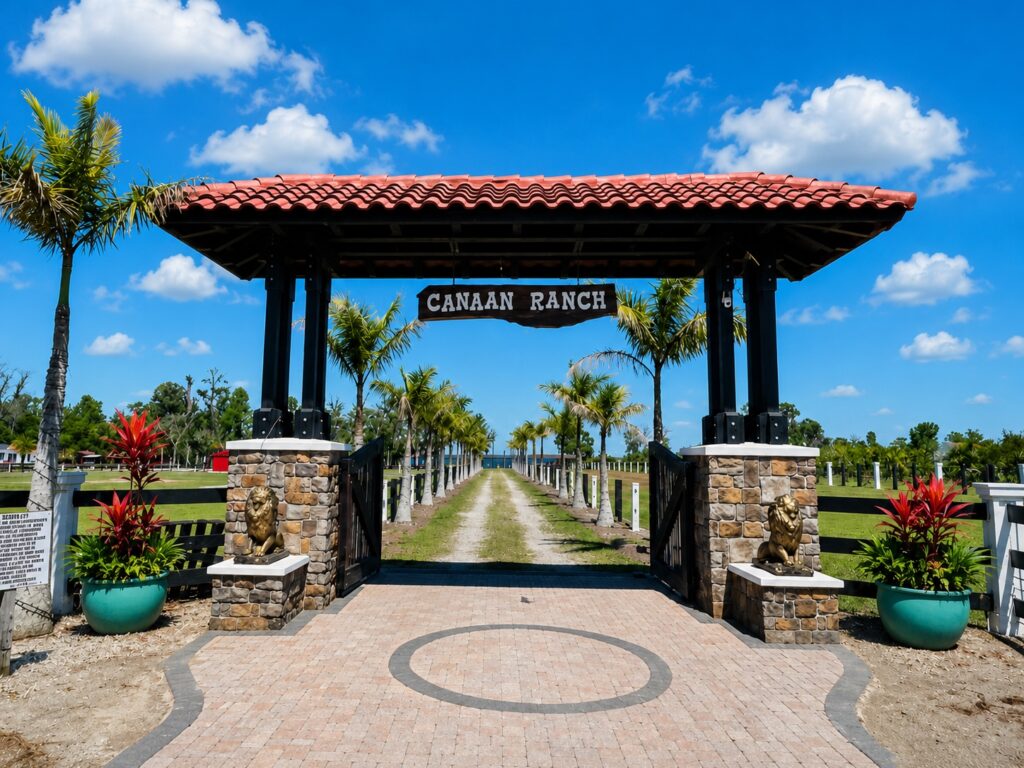
When aligned with modern satellite imagery using those fixed shoreline landmarks, the truth comes into focus: the historic wharf sat near what is today Jeslan Court and Canaan Ranch. This places the original steamboat hub at least 1,000 feet west of today’s Black Hammock pier.
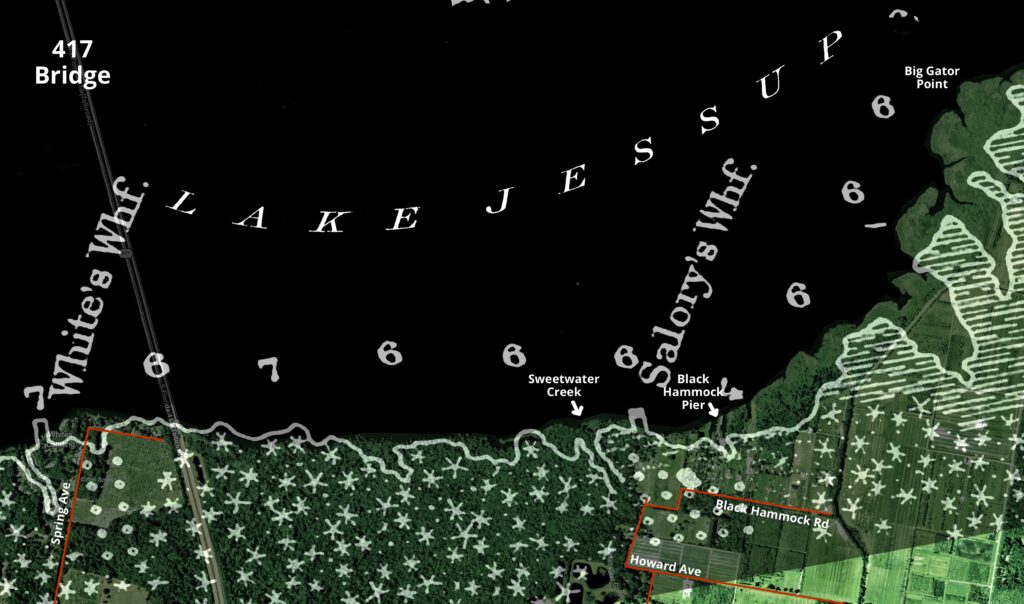
The same 1881 chart also solves the physical puzzle. The depth soundings show only four feet of water near the present-day marina, while the approach to Solary’s site reaches six feet. This confirms the original accounts: Solary specifically chose this spot because its deep channel could accommodate heavy steamboats that shallower docks like Mitchell’s could never receive.
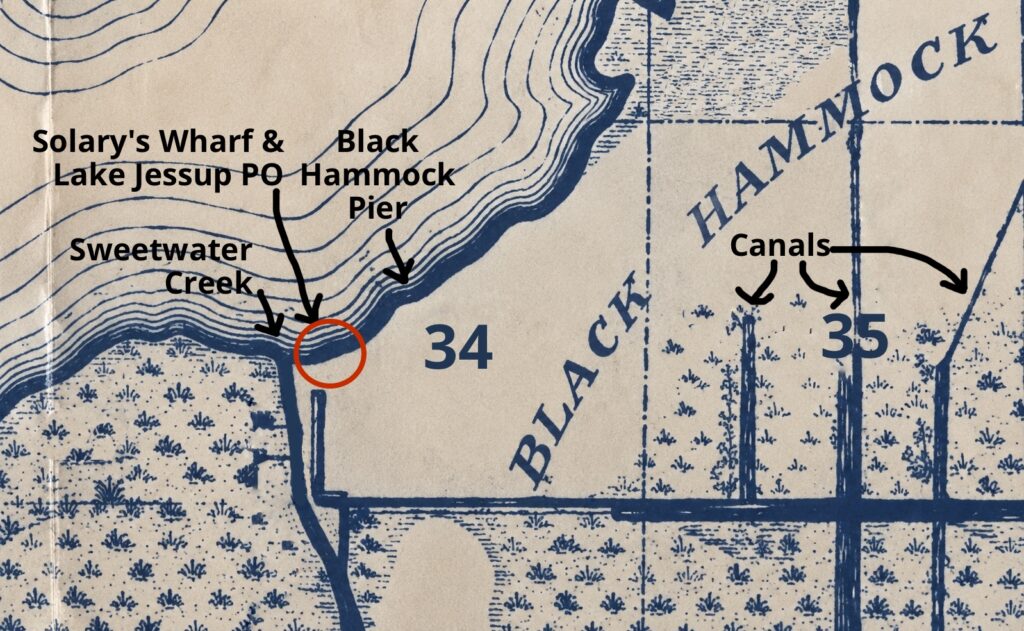
Finally, a restored 1926 map shows the old access road leading straight toward this western site as a natural continuation of Jeslan Court. Notably, no road exists on the map leading to the modern boat ramp. The map also captures the early agricultural canals cut through the Black Hammock in the mid-1910s—drainage projects that exposed rich muckland for farming, but permanently lowered the lake level and altered the shoreline.
Though the bustling steamboat landing eventually surrendered to the railroad and faded into quiet memory, its legacy remains anchored to the shore. Solary’s Wharf was more than a timber dock—it was the true cradle of commercial life for all of southeastern Seminole County.
Sources
- Lake Jessup Post Office location details (1881)
- Lake Jessup Voting Precinct Records (1876)
- Tuskawilla Post Office Application (1876) – References Lake Jessup post office
- US Bureau of Land Management
- Orange County Map, Library of Congress (1890)
- Oviedo: Biography of a Town (Book)
- Florida Railroad History notebook (given to me by Jim Robison)
- Florida Times Union: February 8, 1889
- Florida Times Union: October 12, 1886
- Isis Steamboat Sinks – Florida Agriculturalist: November 15, 1882
- Neighbors Feud while Historians Debate Location of Solary’s Wharf – Orlando Sentinel: September 19, 1993
- Orlando, A Century Plus (Book)
- Orange County Comproller Records
TV
AWESOME!! I used to own the Black Hammock Restaurant in the late 80’s. It used to be called “The Liar’s Lodge” I changed it to “The Staghorn Lodge” in 1986. We always argued about where Solary’s Wharf & Landing were and the Old Times told us it was near Sweetwater Creek. So being that my Dad took me to The Black Hammock Fish Camp in 1957 for the first time to go fishing I fell in love with Lake Jesup and have enjoyed Speck Fishing and Air Boating, Gator hunting ever since. The Fish Camp opened in 1951 when I was born and I bought 20 acres in the Black Hammock Wilderness Area of Seminole County in 1976 and Still live here. It’s called The “Tin House Ranch” off of Stone Street. I will Die Here!!! Mike Logan.