
Crow’s Bluff: The Ghost Town That Leaped the River
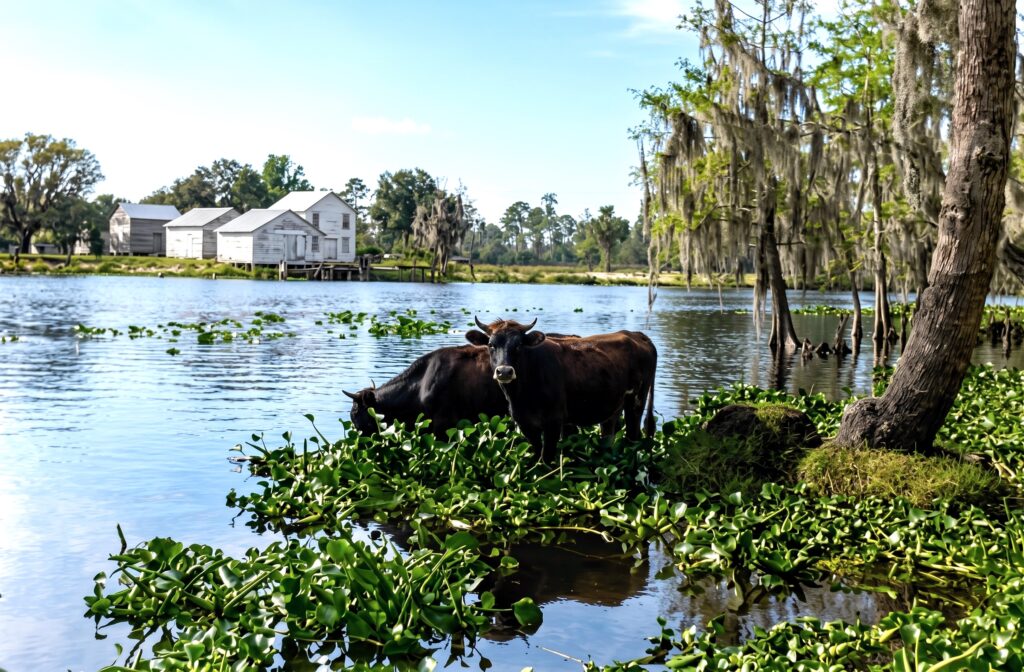
In the days when large steamboats were the only way to pierce the dense jungles of Florida, captains weaving passengers down the St. Johns River toward Hawkinsville (near Deland) sometimes had a little fun with their passengers. “Keep an eye on the west bank,” he’d tell the newcomers. “We’re nearing the home of one of the world’s great curiosities: talking white crows.”
Passengers crowded the rail as the boat swung toward a high bank on the Lake County shore. The captain let loose a couple of blasts on the steam whistle. Out onto the porch of a big house came the Crow family, waving at the boat.
“There they are!” The captain laughed as his passengers groaned.
DeLand historian Bill Dreggors was still getting laughs with that story a hundred years later. By then, the whistles, the sidewheelers, and the riverside Crows were all long gone. So was the town.
A high place in a low country
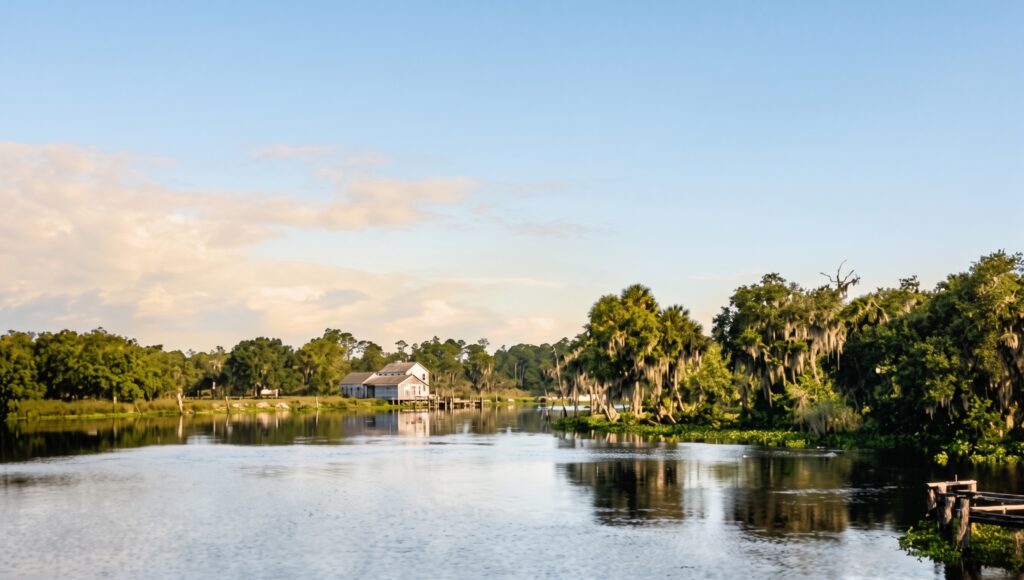
Anyone who has driven State Road 44 west out of DeLand knows the river there is low, wide, and edged with swamp. Except where it has been raised artificially, high ground is rare along this stretch of the St. Johns. Settlers sought out these flood-resistant rises like a magnet.
The naturalist William Bartram rowed past in the 1770s and wrote of a high bluff crowned with “grand magnolia, glorious palms.” The scholar who later traced his route decided that Bartram’s bluff was here.
By the 1850s, a handful of settlers lived on high ground on the west bank. One account says the first name of the place was Ledworth Camp, after a Navy timbering crew. It went by Osceola for a while. However, mail often failed to arrive since other places in the state already claimed that name. By 1858, the post office was renamed Hawkinsville. On an 1868 map, the riverbank dot carries both names, “Oceola” and “Hawkinsville,” directly across the water from a Volusia County spot called “Cabbage Bluff.”
It was a gateway more than a town. In 1859, a fifteen-year-old named William C. G. Kilgore rode out of Hawkinsville with a mail sack bound for Adamsville (The Villages), fifty miles away. He had three days to make the trip and return on horseback. On the first day’s ride, he passed four houses.
In the 1870s, settlers and visitors paid six dollars for a twelve-hour steamboat ride from Jacksonville to Hawkinsville. From there, they went on by mule and wagon, and a stage road ran inland from the landing toward Fort Mason, the settlement that later became Eustis.
The Crows
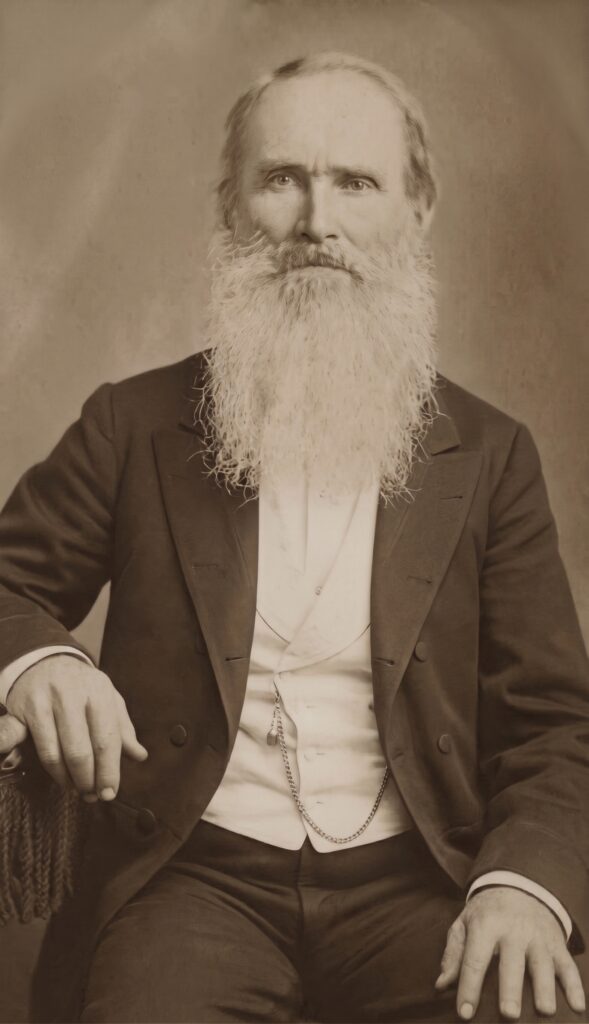
One of the first white settlers near Hawkinsville was Ellison Hillard Crow. He was born in South Carolina in 1819. His descendants remembered him as “a very stately man,” with a long beard and long white hair, who seemed to always be on his horse.
He moved to the western shore of the St. Johns River in 1856 with his wife, Emiley E. Simmons Crow, and their infant son (John Randolph Crow). The Crow household also included an enslaved preteen girl to help with household chores, whose name is lost to history. Emiley bore six more children at their new homestead, which was located just north of the Hawkinsville river boat landing.
Ellison quickly became a prominent citizen, serving as sheriff of Sumter County before the Civil War began. Back then, much of what is now Lake County still belonged to Sumter. When the war came, he enlisted in the Confederacy as a bugler in the Florida cavalry, even though he was already in his forties.
The Crows expanded their land holdings inland, acquiring acreage at Ponceannah, near what is now Paisley. In 1860, he gave land there for a community burial ground. When Ponceannah got a post office in 1877, Ellison was its first postmaster. He partnered with sawmill owner Robert Kirkland to run a general store along the stage road there.
He left their then-of-age son John Randolph Crow in charge of affairs at Hawkinsville. The young entrepreneur became postmaster of Hawkinsville and relocated the office to his property. He expanded the family’s farm to include citrus groves, cabbage, and potatoes. He constructed a steamboat dock, warehouse, citrus packinghouse, and general store next to their two-story home.
Thus the region’s entire commercial center of gravity shifted from the “old Hawksinsville” to the Crow property a mile north. The daily steamboats of the DeBary-Baya Merchants’ Line stopped at John’s dock, and captains began calling it “Crow’s Landing.” On March 23, 1888, it became official: the post office at Crow General Store was renamed from Hawkinsville to Crow’s Bluff.
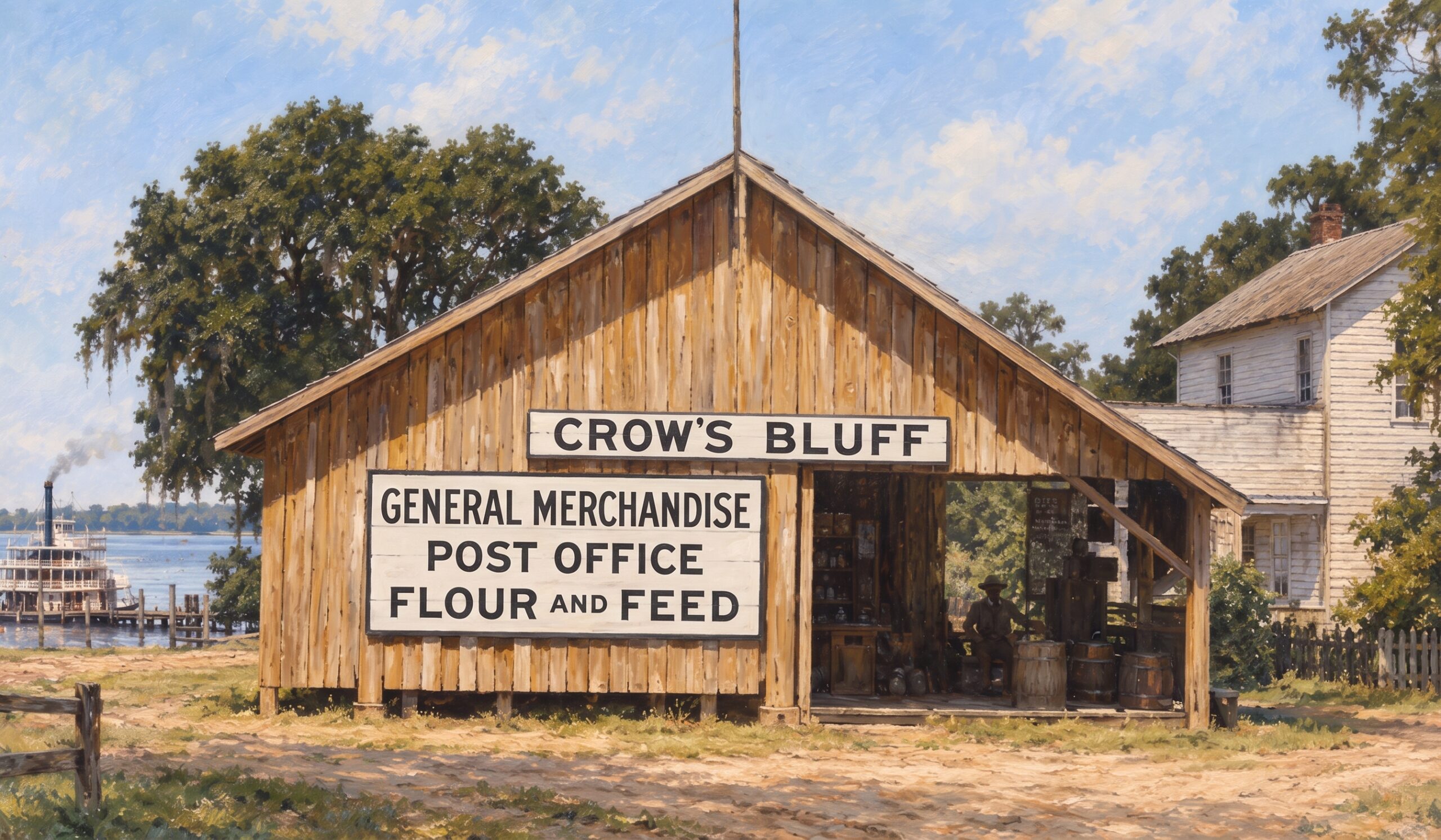
Picture yourself coming down the St. Johns River in a steamship in the 1880s. You round a sharp bend, and a two-story home and small wharf slowly come into view. As you approach the landing, there is the general store (with a post office inside), a repair shop, an orange grove, a flat-bottomed ferry, and several rowboats. A pine-straw paved street extends westward and serves as the town’s main street.
Troy Mason came to Crow’s Bluff as a boy, when his father and uncle started a turpentine business nearby. Decades later, he wrote down what he remembered. The Crow family, he said, “owned and operated everything.”
For those seeking to cross the river, there was no telephone to call the ferryman. Crow had mounted a cowbell on a post on the Volusia County side. A traveler on the far bank rang the bell, and someone came across. Young Troy Mason liked to row and was happy to take foot passengers over in a boat himself. A wagon or a horse went on a small wooden barge that was pulled across the river with a rope. In later years, it ran along a chain with a crank-and-pulley system.
Now and then cattlemen drove a herd down to the river and swam it across. Cur dogs caught the stubborn cows by the lip or the ear and pulled them into the water backward. It could take half a day to get a herd of fifty or seventy-five head across. It was, Mason remembered, “such excitement!!”
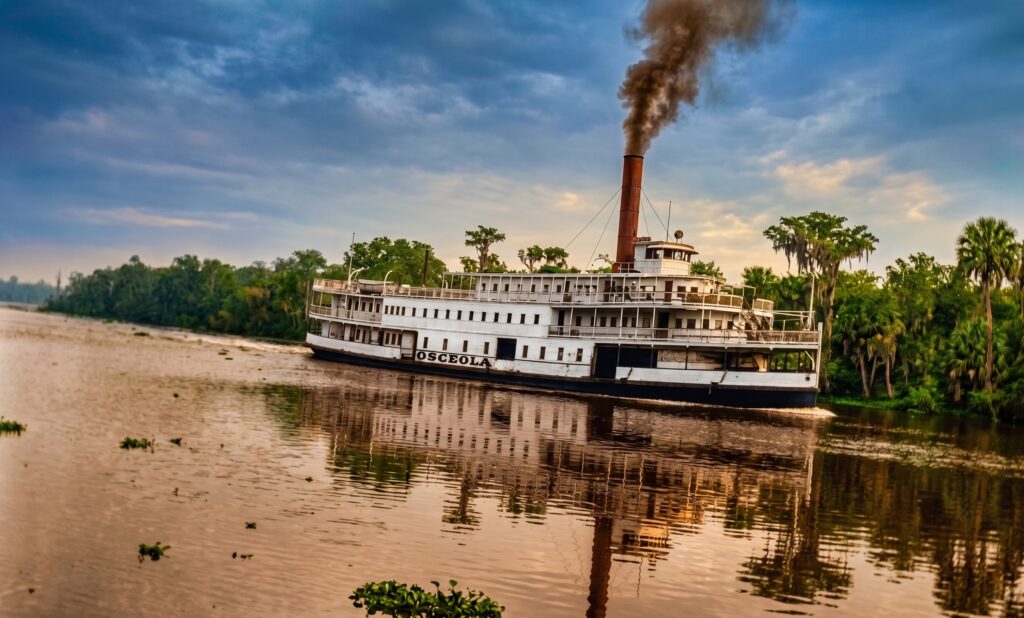
During the winter busy season, the steamboats Frederick DeBary and City of Jacksonville ran daily between Jacksonville and Sanford. “I would hear the whistle blow,” Mason wrote, “and start running to the dock to see her tie up.”
Landowners in the vicinity in 1884 included Beny Anderson, H B Anderson, William Armstrong, William Boatwright, W S Burdett, H E Benedict, John Randolph Crow, Joshua Thomas Crow, L A Dade, Dade & Armstrong, Joseph Evans, W A Davis, William W Dreggors, Rachael Griffin, George W Griffin, L H Jackson, Andrew Owens, M E Owens, J P Owens, Mattie E Rose, Allen S Stoples, S H Turner, W B Wofford, O A Walker.
Life on the bluff had a working rhythm. In the fall of 1894, the merchants at Crow’s Bluff put out word that they would buy all the saw-palmetto berries anyone could pick. They paid up to a dollar a hundred pounds. Among the pickers that season was a twelve-year-old named Walter McLarty, who was locally famous for running a massive rattlesnake in the palmettos and killing it.
That winter the Great Freeze of 1894–95 swept through and blackened Florida’s orange groves. In March the Palatka paper carried a small, hopeful item: at Crow’s Bluff, the orange trees were showing signs of life again.
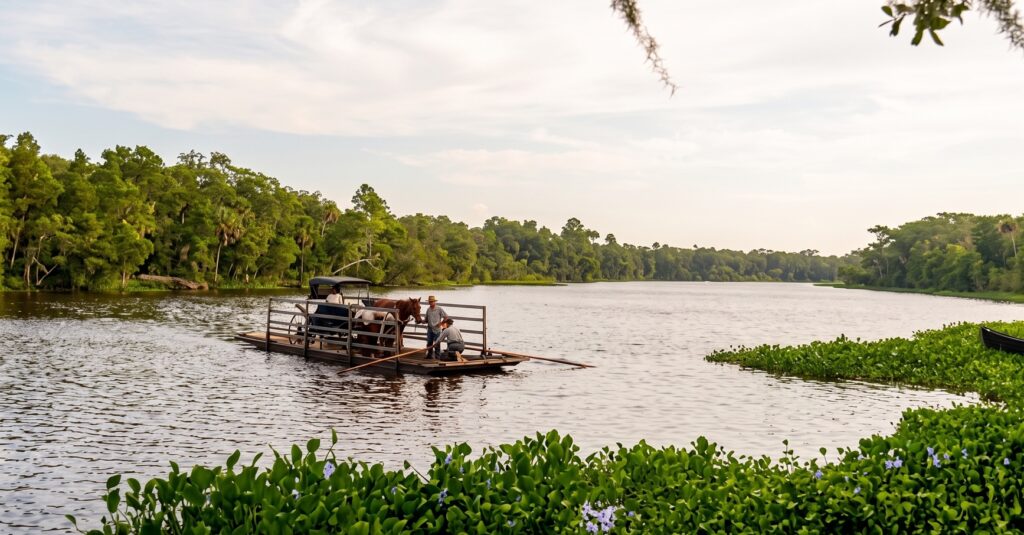
The census of 1900 counted 141 people in the Crow’s Bluff precinct. Most were homesteaders scattered across the backcountry. They came to the bluff for their mail, their supplies, and a way over the river.
Across the river, a railroad was short-lived. A short narrow-gauge line ran from DeLand out to DeLand Landing in 1885 to meet the steamboats. However, once the main line to Jacksonville reached DeLand, freight could go all the way by rail, and nobody needed to load it onto a boat at the river. After a few years, the two miles of track west of DeLand Junction had been pulled up. The old railbed became a road, and that road is Old New York Avenue today.
The rails never did cross the river, though, and there was no bridge. Anyone going west still had to take Crow’s ferry.
Selling the Bluff
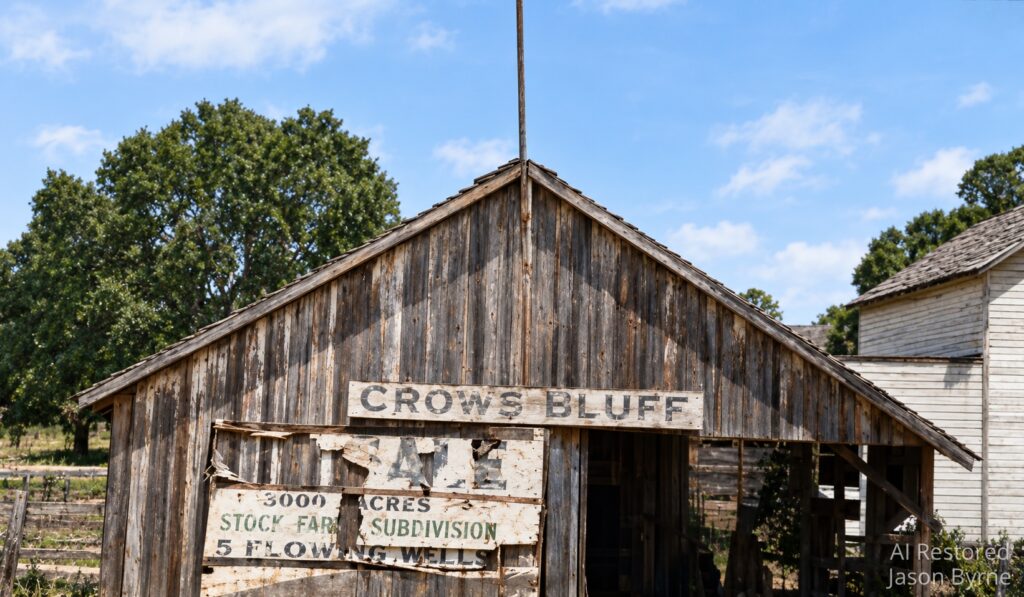
The railroad was the primary factor behind the town’s decline. What had once been a regional shipping port for agriculture is now a relic. The final blow was speedy automobiles that made stopover rest and resupply spots like Crow’s Bluff unnecessary.
In the summer of 1910, John and Mollie Crow sold the family homestead and moved to Port Orange. Sadly, John died suddenly of a heart attack the next February. He was only fifty-four.
The buyer was the Florida Land and Investment Company, a group of Eustis businessmen. The 3,000-acre tract, “together with all buildings, wharfage, ferry, etc.,” came to about three miles of riverfront. They had big plans. Surveyors cut the land into town lots and five-acre farms. Crews began drilling irrigation wells and laying out streets. A hotel was to be built “at once.” The new owners promised a winter resort on one of the prettiest stretches of the St. Johns.
The resort never came. No sign the hotel was ever built. On May 31, 1913, the post office closed, and Crow’s Bluff lost the one official thing that made it a town. After that, its mail came from Beresford, across the river to the southeast.
A free ferry
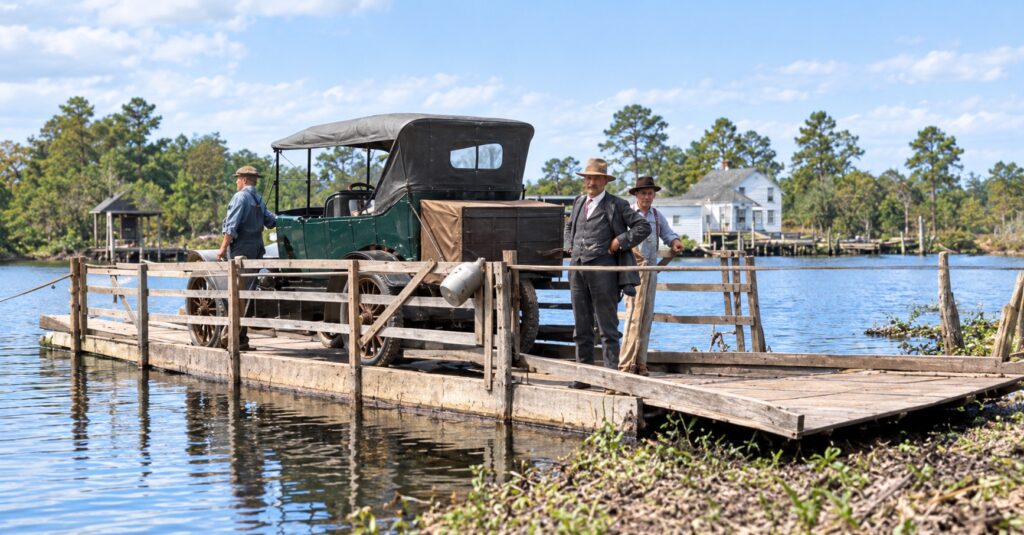
Town or not, the crossing mattered more than ever. The automobile had arrived, and the road through Crow’s Bluff was the direct route from Gainesville, Ocala, and Eustis to DeLand and the coast.
In April 1911, commissioners from Lake and Volusia counties met in DeLand. They agreed to make the Crow’s Bluff ferry free from sunup to eight at night and split the cost. A late traveler paid fifty cents. That December, they hired a ferryman named T.R. Smith.
For the next six years, the counties kept it running. Their minutes list new buying chains to pull the ferry across. They added brand-new lighters, the flat barges that carried wagons and cars.
It was considered the premier ferry in the region. In 1913, a party of motorists from Ocala watched the ferry at Lake Monroe sink under the car behind theirs. On the way home, they went instead via Crow’s Bluff and reported the route “safe and tolerably easy.”
The road to the river needed work, though. It ran from DeLand Junction (the railroad depot) to DeLand Landing (“Cabbage Bluff”), then followed the riverbank to the ferry and bridge. This is the modern-day Old New York Road, a dirt-and-pine-straw road that was so narrow that newspapers warned two vehicles could not pass without danger. Volusia awarded a contract in 1916 to widen and pave the two-mile stretch.
The first bridge
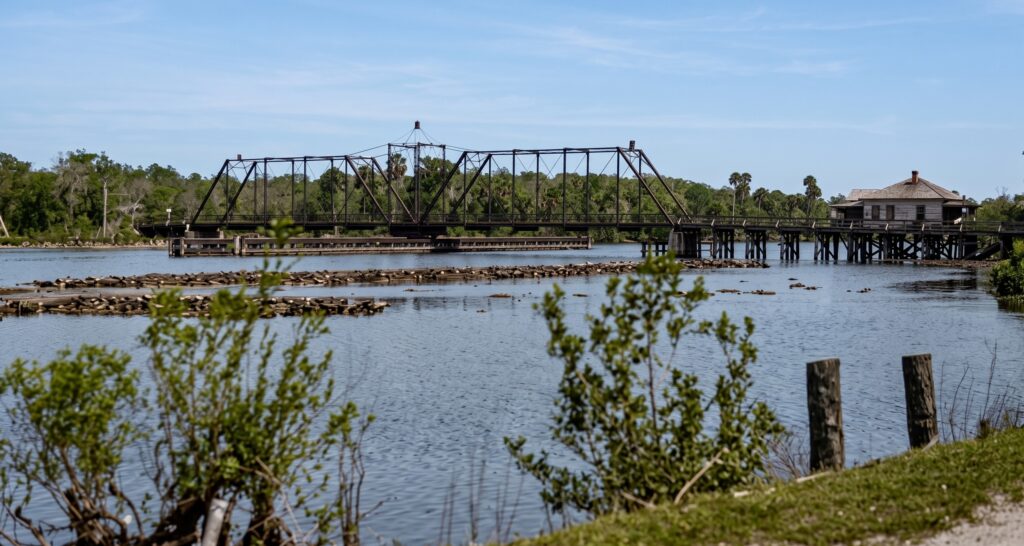
In December 1916, a Daytona man named Michael Sholtz won a ten-year franchise to build a toll bridge at Crow’s Bluff. The War Department asked Sholtz to locate the bridge 400 feet south of Crow’s ferry, clear of the sharp river bend. Construction began swiftly on the 500-foot-long, 18-foot-wide steel swing bridge.
On a Sunday in September 1917, the Crow’s Bluff bridge opened to traffic, and the ferry was shut down for good. An automobile or animal-pulled wagon paid fifty cents to cross the Crow’s Bluff bridge. A foot passenger paid fifteen cents. A person leading one cow, one hog, or one sheep paid a quarter.
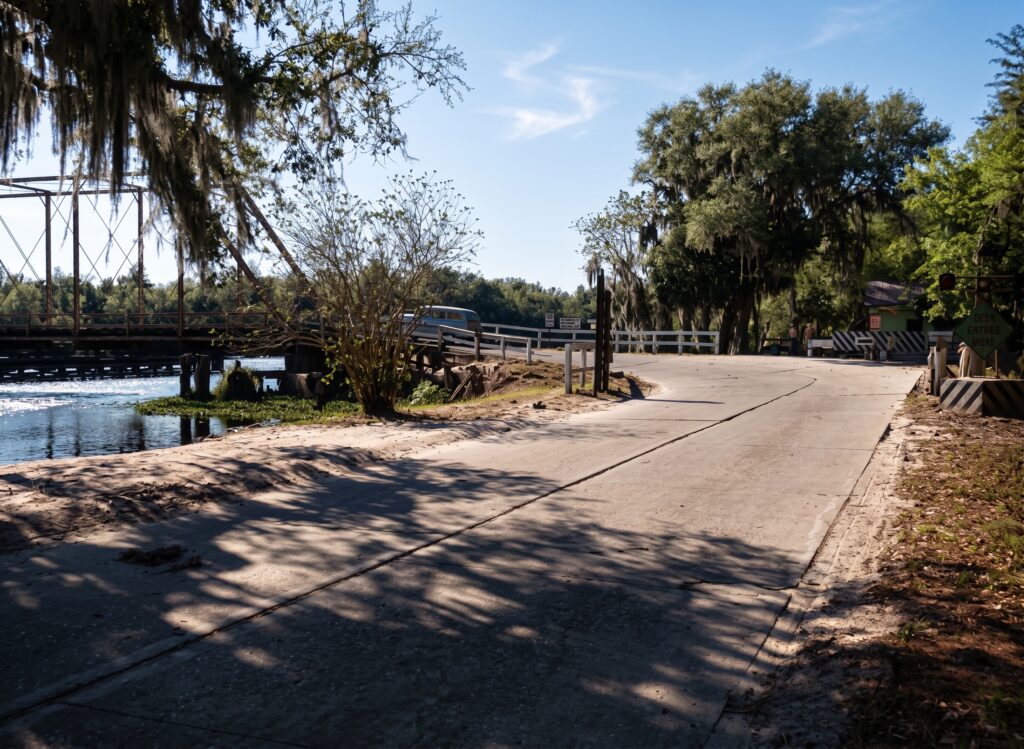
Not everyone cheered. People had been crossing that river for free for years. A month later, petitions were going around asking the counties to bring the free ferry back. They didn’t get it.
However, the toll bridge was never profitable. Sholtz abandoned it and turned control over to Volusia County. In January 1924, it took in $298.15 in tolls, while the Monroe bridge near Sanford took in more than ten times that. In 1926, the county made it free.
The new state highway (now 44) was opened in 1941, replacing Old New York Avenue as the primary route to the river. However, it stopped abruptly at the water’s edge. It was known as a dangerous stretch, with two near “L-curves”: a right turn going north along the river and a left turn at the bridge. In 1947, the old swing bridge was shut down for weeks for repairs, increasing the calls for a modern bridge and to eliminate the sharp turns.
Moving south
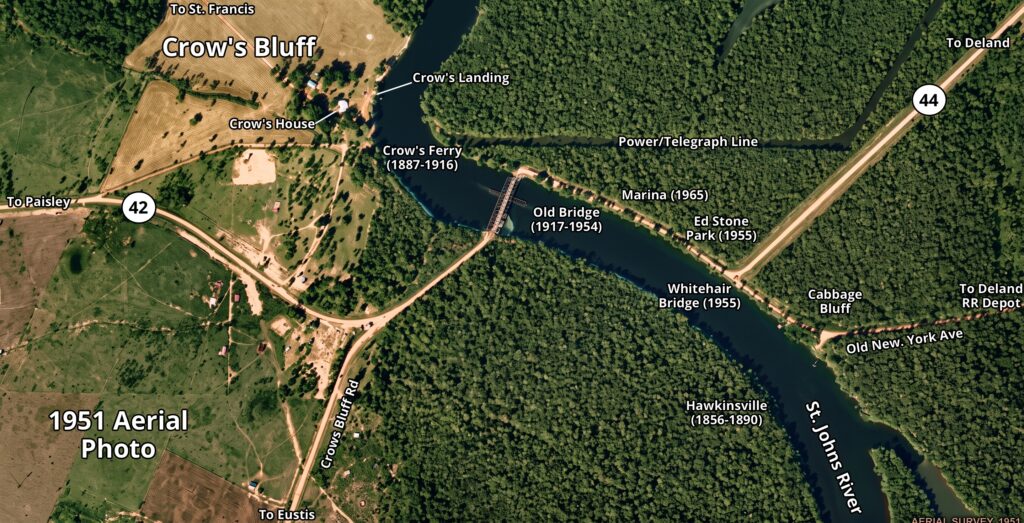
Finally, in 1954, the Department of Transportation began construction of a replacement, located a few hundred yards downstream from the 1916 bridge, on a straightened State Road 44 that was extended into Lake County. Besides funding of the bridge itself, the biggest issue was that the area was a veritable swamp on the Lake County side, which is why it had always crossed at the higher ground at Crow’s Bluff. The state effectively built a causeway on the west side of the river.
On September 22, 1955, bands from Stetson University, Eustis High, and DeLand High played at the dedication of the $750,000 bridge. It was named for Francis Whitehair, the DeLand lawyer and State Road Board member who had pushed for its creation. That evening, there was a free fish fry and a street dance on New York Avenue.
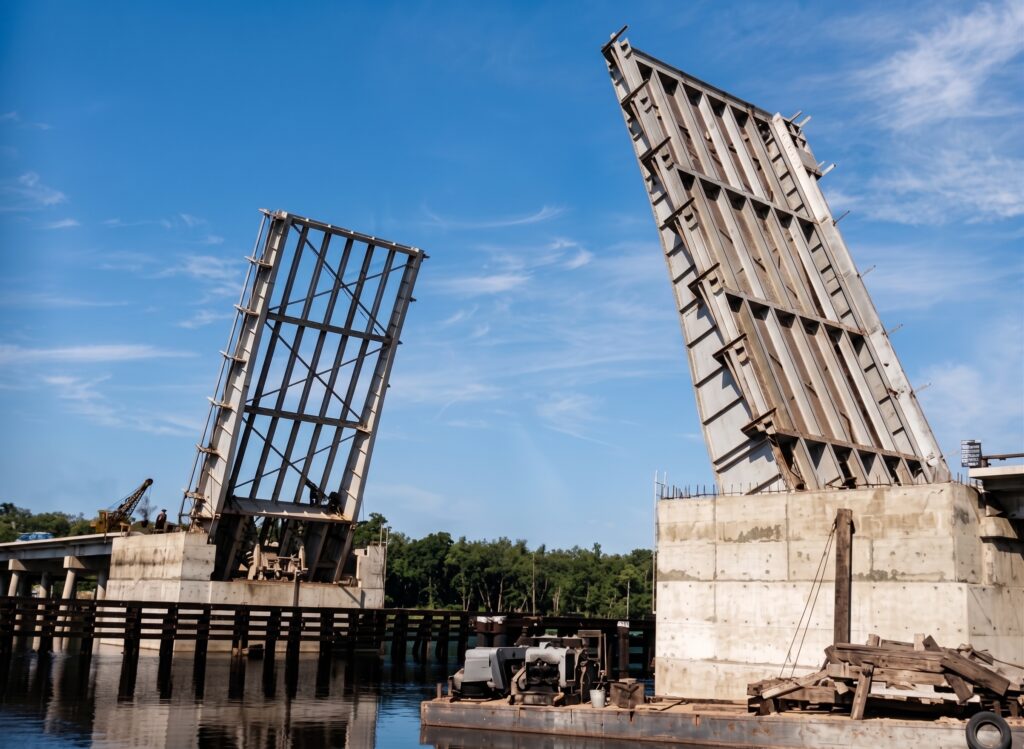
This bridge opened by either side pulling up skyward, rather than rotating horizontally like the old bridge. The Whitehair Bridge served until 2023, when it was replaced by an elevated bridge that let boats pass underneath without interruption.
Identify Theft
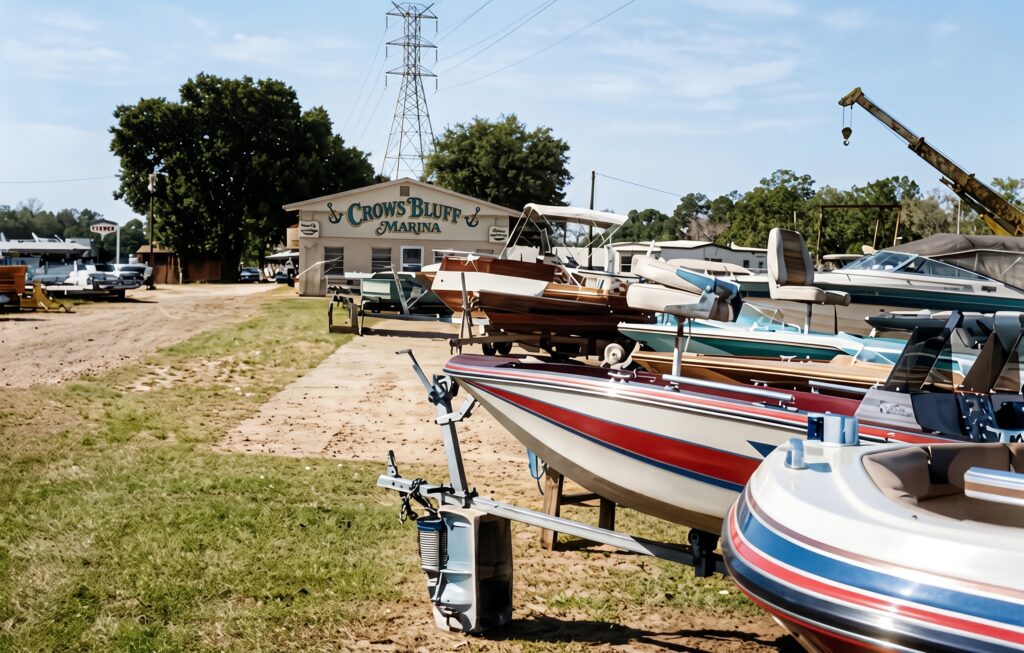
Lake County was unhappy about Volusia County’s plans to build a “Crow’s Bluff Park” on its side of the river, next to the new bridge. An Orlando Sentinel columnist from Lake County complained that the name was being “stolen” right out from under Lake County’s nose. Any loyal Lake Countian’s blood, he wrote, “should boil” at Volusians stealing their history.
After mounting pressure from their Lake County neighbors, Volusia County opted to name it Ed Stone Park instead.
However, a few years later, the east-siders did it again! Ray and Anastasia Linkovich built Crow’s Bluff Marina just north of the park in 1965. The marina dredged sections of the swamp and built a small inlet to house boats. The old bridge tender’s house became a snack bar.
Through numerous ownership changes and even a murder plot (which deserves its own article), it retained the name Crow’s Bluff Marina through the 1990s. For about a decade, it was called Boat Show Marina, and today it is simply St. Johns River Marina
Ghost Town
In 1982, an Orlando Sentinel columnist went searching for the town and found nothing but a hook for his article: “Practically speaking, there is no Crows Bluff, Fla.”
Everything that still carried the name, he noticed, was on the wrong side of the river. The Crows Bluff Marina was over there, beside Ed Stone Park. It was, he wrote, “as if all the history of Crows Bluff leaped the river and settled on the marina.”
Even back then, the folks he interviewed had long forgotten about the namesake family. One Crow’s Bluff Marina worker pointed at three oak trees near the snack bar that used to be the bridge tender’s house. “The crows will come back in any week now,” Cindy Durham said, “and they’ll stay through the winter. There’ll be thousands of them.”
Across the highway, at the Shady Oaks fish camp, a hole-in-the-wall bar and restaurant that still exists, the reporter interviewed Otis, the owner of the joint. “What they call Crows Bluff — that marina — ain’t that at all,” he told the journalist. Then he pointed toward the Lake County bank, but “ain’t a damn thing over there.”
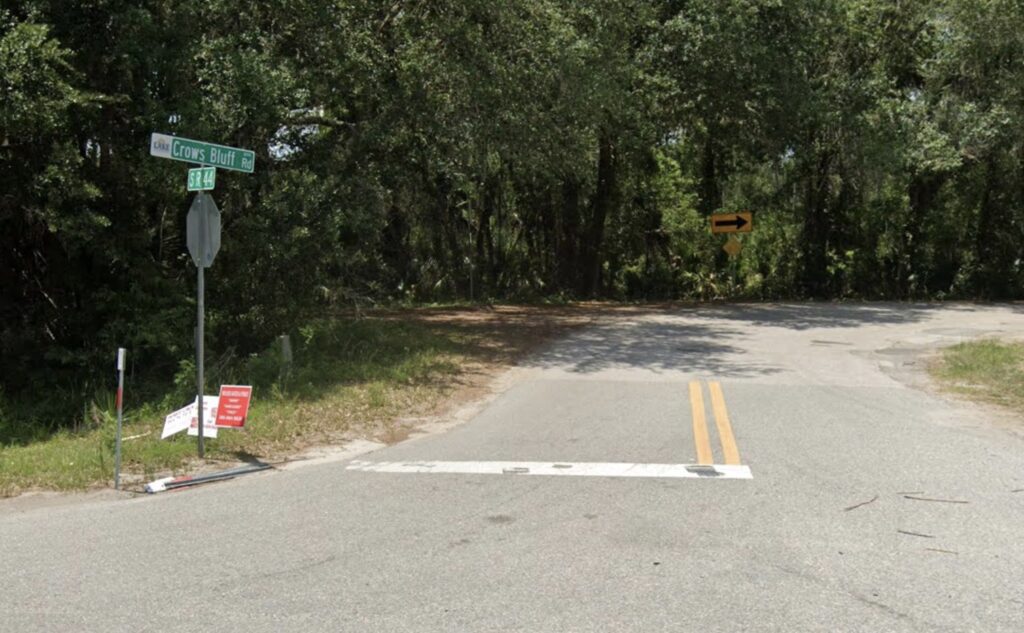
Today a new elevated bridge carries State Road 44 over the St. Johns, soaring over Shady Oaks and old Crow’s Bluff. On the Volusia side, the marina has a new name, St. Johns River Marina, and Ed Stone Park and Boat Ramp sits between the marina and the bridge. Even the name that leaped the river has faded. Most drivers never notice the little country road on the Lake County side called Crows Bluff Road. It runs a few hundred yards through the woods, then stops at County Road 42.
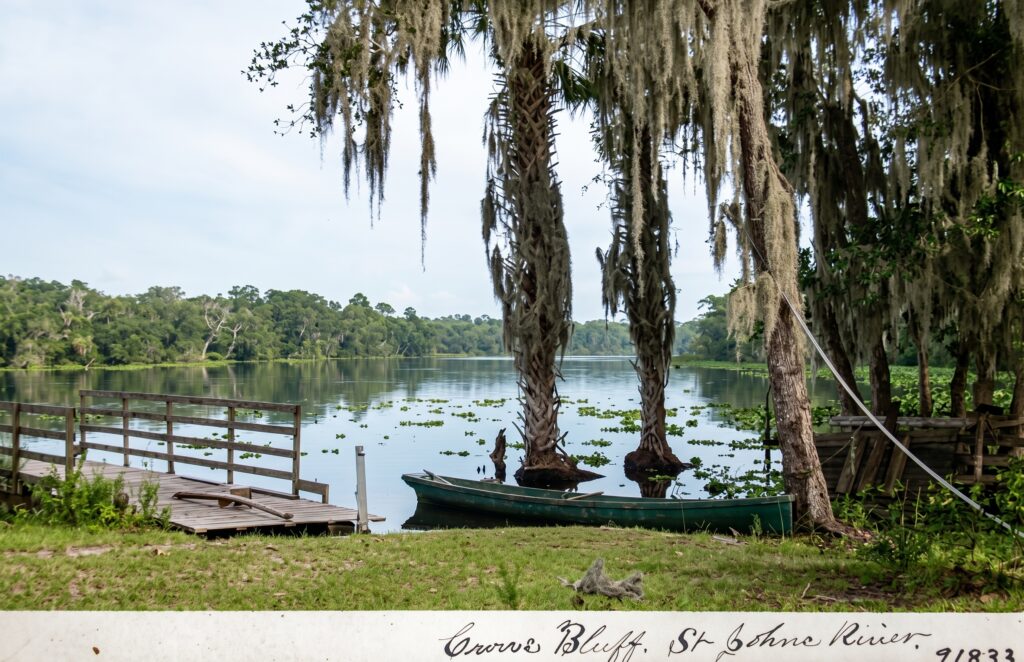
If you want to visit real Crow’s Bluff, take the dirt road to River Forest Group Camping Area. Then wander back toward the river, near where the power lines cross it. And then listen. Maybe you can hear the faint echo of a steamboat whistle. That is where the cowbell hung on its post, where Troy Mason ran to watch the steamboats tie up, and where the Crows waved from their porch at the passing tourists.
Sources
The story of Crow’s Bluff survives mostly in scraps: county commission minutes, a few paragraphs in old newspapers, post office ledgers, and the memories of people who wrote them down late in life.
A handful of pieces did the heaviest lifting:
- Howard Means, “Crows Bluff — it doesn’t take much to get on the map,” Orlando Sentinel, October 19, 1982, and his follow-up on the Crow family, November 2, 1982
- Dianne Copelon’s profile of historian Bill Dreggors, Orlando Sentinel, August 3, 1995
- Jim Robison’s column recounting Troy Mason’s memoir of boyhood at Crow’s Bluff, Orlando Sentinel, April 23, 2000
- Ormund Powers on Lake County place names, Orlando Sentinel, July 1, 1998
- Ron Williamson’s column on Bill Dreggors and the talking white crows, The News-Journal (Daytona Beach), July 24, 1995
- “Another Colony on the St. Johns,” The Florida Times-Union, July 19, 1910, on the sale of John Crow’s land, ferry and store
- “Lake and Volusia counties agree to make Crow’s Bluff ferry free,” Jacksonville Journal, April 25, 1911
- “M. Sholtz Receives Permit for Bridge,” The Daytona Beach News-Journal, March 21, 1917
- Art Raynor, “Crow’s Bluff May Be Moved,” Orlando Sentinel, June 10, 1954, and the bridge dedication notice of September 15, 1955
Other contemporary accounts came from The Palatka Times-Herald, The Daytona Gazette-News, The DeLand Weekly News, The DeLand News, The New Smyrna Daily News, The Ocala Evening Star, The Volusia County Record, The Bradford County Telegraph, The St. Augustine Record, The Palm Beach Post, and The DeLand Sun News.
Photographs, maps, and steamboat-era images are from Florida Memory, the State Library and Archives of Florida. Digitized newspapers and state documents came from the University of Florida Digital Collections. Aerial photographs from 1951 through 1993 are from the Volusia County GIS Historical Aerial Viewer, with later imagery from Google Earth.
Post office dates come from published Florida postal histories and postalhistory.com. Business listings are from the Florida State Gazetteer and Business Directory, 1884. Family dates are from Find a Grave. Background on DeLand Landing and the short-track railroad comes from the DeLand Historical Society and Volusia County’s DeLand Historical Trail, and background on Ponceannah comes from Steve Rajtar’s Paisley Historical Trail (2008) and the Ponceannah Cemetery history.